 Image 1 of 1
Do you lose yourself trying to stay connected?
Maybe you overthink unanswered messages, need repeated reassurance, hide your needs to avoid conflict, or become emotionally distant when closeness feels uncomfortable. You may understand these patterns intellectually—but still find yourself repeating them when a relationship feels uncertain.
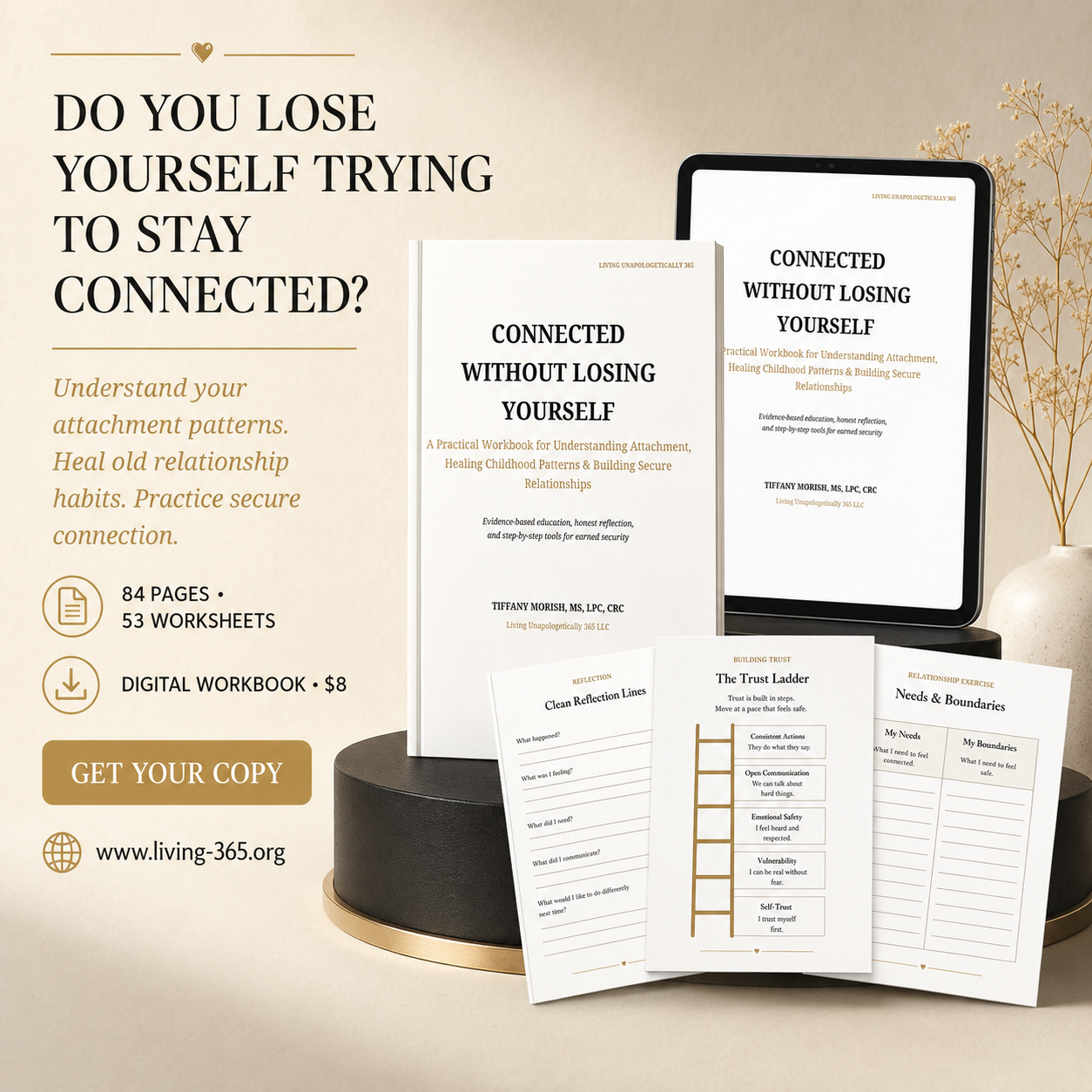
Connected Without Losing Yourself is an evidence-based, trauma-informed digital workbook created by Tiffany Morish, MS, LPC, CRC. It helps you understand how childhood experiences may influence adult attachment patterns—and, more importantly, how to begin practicing safer and more secure ways of connecting.
This 84-page workbook includes 53 guided worksheets and review exercises to help you:
✓ Explore attachment anxiety and avoidance without forcing yourself into a rigid label
✓ Identify anxious, avoidant, fearful, secure, and mixed relationship patterns
✓ Understand how childhood caregiving, inconsistency, parentification, rejection, or emotional unavailability may affect adult relationships
✓ Recognize attachment triggers, emotional flooding, protest behaviors, shutdown, and hyper-independence
✓ Separate present relationship facts from childhood fears
✓ Reduce repeated reassurance-seeking, overexplaining, rescuing, and people-pleasing
✓ Practice self-soothing and internal validation
✓ Strengthen boundaries without automatically feeling guilty or abandoning yourself
✓ Evaluate trust, consistency, reciprocity, and relationship potential more clearly
✓ Communicate needs directly and use secure pause-and-return strategies during conflict
✓ Work through Adult Self vs. Child Self and reparenting exercises
✓ Follow a structured six-week earned-security plan
Every worksheet includes detailed step-by-step directions, reflection space, and worked examples. The book also includes warm, appropriate humor—because healing is serious work, but every unanswered text does not need a congressional investigation.
Attachment patterns are not permanent identities. They are learned strategies for managing closeness, distance, vulnerability, and emotional safety. With awareness, practice, supportive relationships, and professional help when needed, those strategies can change.
Digital workbook: $10
84 pages • 53 worksheets
Immediate digital access
Created by Tiffany Morish, MS, LPC, CRC
Living Unapologetically 365 LLC
Get your copy at www.living-365.org.
This workbook provides educational self-help information and is not psychotherapy, diagnosis, crisis care, or a substitute for individualized mental-health treatment.
Do you lose yourself trying to stay connected?
Maybe you overthink unanswered messages, need repeated reassurance, hide your needs to avoid conflict, or become emotionally distant when closeness feels uncomfortable. You may understand these patterns intellectually—but still find yourself repeating them when a relationship feels uncertain.
Connected Without Losing Yourself is an evidence-based, trauma-informed digital workbook created by Tiffany Morish, MS, LPC, CRC. It helps you understand how childhood experiences may influence adult attachment patterns—and, more importantly, how to begin practicing safer and more secure ways of connecting.
This 84-page workbook includes 53 guided worksheets and review exercises to help you:
✓ Explore attachment anxiety and avoidance without forcing yourself into a rigid label
✓ Identify anxious, avoidant, fearful, secure, and mixed relationship patterns
✓ Understand how childhood caregiving, inconsistency, parentification, rejection, or emotional unavailability may affect adult relationships
✓ Recognize attachment triggers, emotional flooding, protest behaviors, shutdown, and hyper-independence
✓ Separate present relationship facts from childhood fears
✓ Reduce repeated reassurance-seeking, overexplaining, rescuing, and people-pleasing
✓ Practice self-soothing and internal validation
✓ Strengthen boundaries without automatically feeling guilty or abandoning yourself
✓ Evaluate trust, consistency, reciprocity, and relationship potential more clearly
✓ Communicate needs directly and use secure pause-and-return strategies during conflict
✓ Work through Adult Self vs. Child Self and reparenting exercises
✓ Follow a structured six-week earned-security plan
Every worksheet includes detailed step-by-step directions, reflection space, and worked examples. The book also includes warm, appropriate humor—because healing is serious work, but every unanswered text does not need a congressional investigation.
Attachment patterns are not permanent identities. They are learned strategies for managing closeness, distance, vulnerability, and emotional safety. With awareness, practice, supportive relationships, and professional help when needed, those strategies can change.
Digital workbook: $10
84 pages • 53 worksheets
Immediate digital access
Created by Tiffany Morish, MS, LPC, CRC
Living Unapologetically 365 LLC
Get your copy at www.living-365.org.
This workbook provides educational self-help information and is not psychotherapy, diagnosis, crisis care, or a substitute for individualized mental-health treatment.